How it works
go-bpm turns a process diagram into Go code before the service starts. The engine uses PostgreSQL to persist queued work, token state, instances and optional history.
BPMN and tokens#
BPMN is a standard notation for business processes. A .bpmn file is XML containing executable elements and diagram coordinates.
Think of execution as a token moving through a diagram. A start event creates the token; sequence flows move it to tasks; exclusive gateways select one branch and parallel gateways create several. An end event finishes a token. One run of a process is an instance, with its own variables and business key.
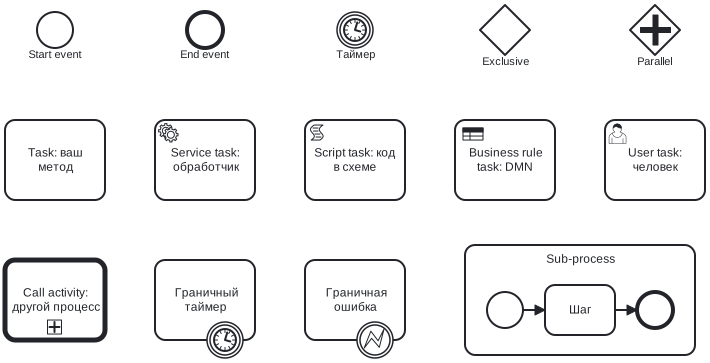
| Element | Purpose |
|---|---|
| Task | Run a Go method synchronously |
| Service task | Enqueue a handler with its own retries |
| Script task | Calculate values in a generated Go function |
| User task | Wait for a person |
| Business rule task | Evaluate a DMN table |
| Exclusive gateway | Choose the first matching branch or the default |
| Parallel gateway | Split into all branches or wait for all inputs |
| Intermediate timer | Wait for a duration or date |
| Boundary event | Interrupt a supported task on an error or timeout |
| Subprocess / call activity | Run a child process instance |
See BPMN modeling for supported configurations and restrictions.
DMN decisions#
DMN represents business rules in decision tables. Each row is a rule, input cells are tests, and output cells contain results. All input tests must match for a row to apply. The hit policy determines whether to take the first match, return multiple matches or aggregate them.
| Amount | Customer category | Discount |
|---|---|---|
>= 10000 | "vip" | 15 |
>= 10000 | - | 10 |
- | "vip" | 5 |
- | - | 0 |
A business rule task reads inputs from process variables and writes the result back. See DMN decisions.
Generation and deployment#
process/*.bpmn and *.dmn
         ↓ go-bpm-gen
Go transitions, conditions, scripts, decisions and method stubs
         ↓ go build
your service + engine + queue → PostgreSQL
The generator builds the generated packages, catching invalid expressions, missing model fields and incorrect method signatures. Processes are versioned and reviewed with service code. Changing a process requires rebuilding and deploying the service.
Queued steps#
Workers claim tasks with SELECT ... FOR UPDATE SKIP LOCKED. Multiple service replicas can share the same database.
A queue task executes one step. A step moves the token through synchronous elements until it must wait: a service task, timer, user task, message, parallel join or process completion. A chain of ordinary methods can run in one step. Parallel branches containing only synchronous methods execute sequentially within that step; service task branches can run concurrently as separate queue tasks.
Transaction guarantees#
Queue task completion, new queued tasks, element and rule history, instance state, user tasks and parallel join counters commit in one database transaction. A step either commits entirely or rolls back entirely.
The queue retries a rolled-back step, including its synchronous methods. External effects such as payments and email need idempotent service task handlers. Service tasks provide at-least-once execution: a handler may finish before its completion transaction fails. An idempotency key can combine job.InstanceUid and job.ElementId; for a repeated activity, include its logical occurrence as needed by your integration.
Retries and failures#
| Failure | Result |
|---|---|
| Method, condition or DMN evaluation | Roll back and retry the system step |
| Service task handler | Retry its queue task according to BPMN retries |
Matching bpm.NewError(code, ...) | Follow the boundary error flow |
| Attempts exhausted | Mark the task, instance and ancestors as failed |
System steps default to 10 attempts. Retry delay starts at one second, doubles up to five minutes and includes jitter. Failed tasks remain available for diagnosis and manual retry.
Variables and the data model#
Instance variables are JSON. Methods receive a typed *model.DataModel; JSON tags map fields to variables. The model is shared by all processes in a service.
After a method, all model fields are merged back, including zero values. A zero-valued omitempty field leaves its variable unchanged. Variables absent from the model are preserved. Nested structs support paths such as client.age.
Instances and history#
Database history is optional and disabled by default. Enable History.ToDB for instances and element history, and RulesHistory.ToDB for matched DMN rules.
Element events are activated, completed and terminated. Instance states include running, completed, failed and cancelled. A new instance is visible as running as soon as its start task is committed, even before the first step executes.
Embedded subprocesses and call activities create child instances with a parent link, copied variables and an inherited business key. The parent waits for completion. Call activities normally propagate child variables back; propagateAllChildVariables=false keeps the parent's previous variables. A failed child also fails its ancestors.
User tasks#
An assignee receives a personal task. Candidate users or groups share a queue; one person claims the task, then completes it. Unclaim returns it to the candidate queue. With no assignment restrictions, anyone can claim it. Only the assignee can complete a task; submitted variables merge into the process.
The service supplies user IDs and groups and implements authentication and authorization. The engine does not authenticate users.