DMN decisions
DMN tables compile into Go functions over the typed data model. Conditions become Go comparisons; there is no runtime FEEL interpreter. Unsupported expressions fail during generation or compilation.
Connect a decision#
- Create a DMN decision table in the modeler and save it under
process/. - Add a business rule task with its decision ID and result variable.
- Add model fields for the inputs and outputs, then regenerate.
<bpmn:businessRuleTask id="CalcOffer" name="Calculate discount">
  <bpmn:extensionElements>
    <zeebe:calledDecision decisionId="Offer" resultVariable="offer" />
  </bpmn:extensionElements>
</bpmn:businessRuleTask>
Decision IDs are unique across the input directory. A decision can be reused by several tasks and processes. The generator creates a decision function in each calling process package and a method that records matched rule IDs and writes the result.
Example: discount#
A table named Offer with FIRST hit policy:
| Rule | amount (number) | category (string) | discount (number) | reason (string) |
|---|---|---|---|---|
| VipBig | >= 10000 | "vip" | 15 | "large VIP order" |
| Big | >= 10000 | - | 10 | "large order" |
| Status | [1000..10000[ | "vip","gold" | 5 | "customer status" |
For multiple outputs, the result variable is a struct with fields corresponding to output names, not labels:
type DataModel struct {
    Amount   float64 `json:"amount"`
    Category string  `json:"category"`
    Offer    Offer   `json:"offer"`
}

type Offer struct {
    Discount float64 `json:"discount"`
    Reason   string  `json:"reason"`
}Inputs#
The Input Expression names a variable or expression: amount maps to data.Amount, client.age to data.Client.Age. JSON tags can also contain spaces. Expressions are translated in the same way as gateway conditions.
Each input is evaluated once. Types come from typeRef, model fields or literals: number/double map to float64, integer/long to int, plus string and boolean. Inputs with only wildcard tests do not need a model field.
Input cells#
| Cell | Meaning |
|---|---|
Empty or - | Match any value |
"vip", 5, true | Equality |
limit | Equality with a model field |
< 5, <= 5, > 5, >= 5 | Comparison |
[1..10] | Inclusive range |
]1..10[ or (1..10) | Exclusive range |
[1..10[ or (1..10] | Mixed bounds |
"vip","gold" | Any listed value |
not("vip"), not(< 5) | Negation |
? > a + 1 | Expression using the current input |
null | Nil input field |
null requires a nil-capable field: a pointer, map, slice or any. A value field such as float64 cannot distinguish a missing variable from zero. Pointer comparisons use the pointed-to value, with nil treated as the zero value for non-null tests.
Outputs#
One output writes directly into the result field. Multiple outputs write named fields of a result struct; nil struct pointers are allocated. List policies use slices, or slices of structs for multiple outputs. Empty output cells use the type's zero value.
Hit policies#
| Policy | Result | No match |
|---|---|---|
UNIQUE, default | First matching row | Leave result unchanged |
FIRST | First matching row | Leave unchanged |
ANY | First matching row | Leave unchanged |
RULE ORDER | All matches in table order | Empty slice |
COLLECT | All matching results | Empty slice |
COLLECT SUM, MIN, MAX | Numeric aggregation, one output | Leave unchanged |
COLLECT COUNT | Number of matching rules | Zero |
PRIORITY, OUTPUT ORDER | Unsupported | Generation error |
Overlapping rules are not checked for UNIQUE or ANY. Both return the first match. Choose FIRST explicitly when ordering matters. In first-match policies, rules after an unconditional wildcard row are unreachable and are not generated.
For example, a COLLECT SUM fee table can combine a base fee of 100, a large-order fee of 200 and an urgent-order fee of 300. If all three rows match, the result is 600 and history includes all three rule IDs.
Rule history#
Enable Config.RulesHistory to record decision ID, matched rule IDs and result in logs or bpm_rules_history. Records commit with the process step; failed or interrupted steps do not leave partial rule history.
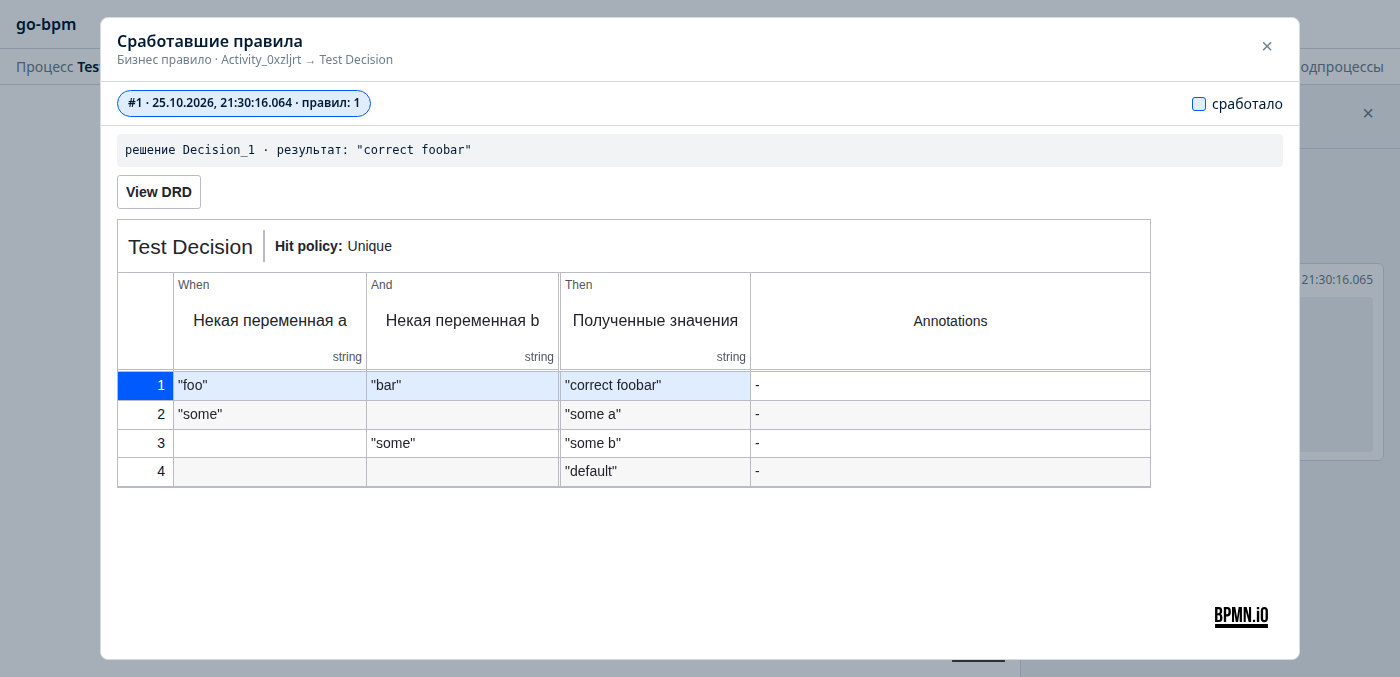
In instance history, open a business rule task and select the matched-rules action. The console shows the decision table with matching rows highlighted. For repeated tasks, switch between calls. Input values are in element history variables, rather than a separate rule-history input record.
Limitations#
Literal-expression decisions, requiredDecision dependencies, PRIORITY, OUTPUT ORDER and worker-based business rule tasks are rejected. Every business rule task needs a decision ID and result variable.
General FEEL functions, dates, durations, contexts and FEEL lists are not translated. Prepare complex inputs in a Go method before evaluating the decision; for example, compute isWorkingDay before the DMN task.